

The Momentum Paradox: How High-Achievers Master the Art of the Workday Break: In the culture of high performance, we often mistake “presence” for “productivity.” We’ve been conditioned to believe that achievement is a linear path; that the harder and longer we stay anchored to a desk, the more we accomplish.
However, the reality of peak performance is non-linear. According to research into human energy cycles, the most productive professionals don’t work in a straight line; they work in pulses. They understand that to maintain high-level momentum, you don’t need to work longer, you need to master the strategic reset.
At Brick & Mortar, we build our environments around this biological reality. Whether you are working out of our Chicagoland offices in Park Ridge, Deerfield, Glen Ellyn, Libertyville, or Arlington Heights, our goal is to provide a space where you can manage your energy to ensure your output remains elite. Here is the framework for breaking up your workday to maximize momentum and achievement.
1. The 90-Minute Sprint (The Ultradian Rhythm)
Our brains are not designed for eight hours of continuous focus. Biology dictates that we operate on “ultradian rhythms” cycles of high-frequency brain activity followed by recovery periods that occur roughly every 90 to 120 minutes.
When you ignore these natural dips, your brain begins to rely on stress hormones like cortisol to stay alert. This results in the “afternoon slump” and a significant drop in decision-making quality. Research published in the Harvard Business Review suggests that honoring these cycles is the single most important practice for maintaining high-level performance throughout the day.
The Strategy: Treat your workday like a series of high-impact sprints. Focus intensely for 90 minutes, then intentionally shift your state. Our locations are designed to facilitate this physical transition. Moving from a dedicated desk to a common lounge or a phone booth for a quick change of scenery signals to your brain that one output cycle has ended and a new one is beginning.
2. The Stanford Effect: Movement as a Cognitive Catalyst
The most common mistake professionals make is taking a “digital break.” Swiping through a phone or checking the news does not rest the prefrontal cortex; it simply switches the type of information it has to process.
A study from Stanford University found that walking, whether indoors or outdoors, boosts creative output by an average of 60%. The act of walking allows the mind to enter a state of “diffuse thinking,” where the subconscious can solve complex problems that the conscious mind couldn’t “brute force” while sitting.
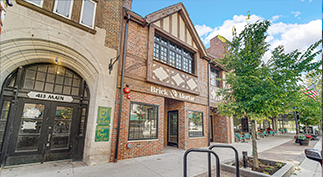
The Strategy: Leverage the “Home Court Advantage” We didn’t choose our locations by accident. Every Brick & Mortar space, from Libertyville and Arlington Heights to Glen Ellyn, Park Ridge, and Deerfield, is intentionally situated in the heart of walkable, vibrant downtowns. This is your “Home Court Advantage.” Instead of a fluorescent-lit breakroom, your office extends to the local boutiques, historic neighborhoods, and curated green spaces just outside our doors. We selected these incredible locations so members could benefit from a walk around town, a stroll through adjacent beautiful neighborhoods, or a quick walk to a local lunch spot.
A five-minute walk through these local districts isn’t just a break; it’s a strategic reset. By moving your body and changing your visual field, you flush stress hormones and return to your desk with a renewed “focus-to-fatigue” ratio.
3. The Hemingway Bridge (The Open Loop Technique)
Many high-achievers fear taking breaks because they don’t want to lose their “train of thought.” This is solved by a technique famously used by Ernest Hemingway, often called the “Hemingway Bridge.”
The Strategy: Never stop working when you are stuck; stop when you know exactly what the next move is. Before you step away to grab a coffee in our cafe or head out for a mid-day reset, write down the very next sentence or the first three steps of the next task. This “bridges” the gap between rest and work, allowing you to re-enter a flow state in seconds rather than minutes.
4. Environmental Anchoring and Context Switching
One of the primary benefits of a dedicated professional workspace is the elimination of “context switching.” At home, your brain is constantly bombarded with domestic cues (the laundry, the TV, the kitchen) that pull at your attention.
By utilizing a professional environment you create an “Environmental Anchor.” Within these walls, your brain is primed for high-impact tasks. When you step out for a break, you are physically leaving the “performance zone,” which allows for a more complete mental recovery.
5. The Casual Collision: Social Architecture
Isolation is a momentum killer, but traditional office interruptions are equally damaging. The solution is the “Casual Collision” a brief, high-quality interaction with another high-achiever.
Research by the University of Michigan highlights that these unplanned interactions can significantly increase productivity and innovation. In our common areas, you might have a 2-minute conversation that provides a social reset and a fresh perspective, keeping you energized without the productivity drain of a 30-minute scheduled meeting.
6. The Closing Ritual: Building Tomorrow’s Momentum
Momentum for the next day is built during the final fifteen minutes of the current one. Because our members have significantly shorter commutes, often less than 10 minutes to their neighborhood’s Brick & Mortar, the “buffer” between the office and home is minimal. This requires a conscious effort to “shut down” the professional mind.
The Strategy:
1. Clear the Deck: Tidy your physical and digital workspace.
2. The Priority Three: Write down the three most important tasks for tomorrow.
3. The Final Exit: Once you leave the Brick & Mortar doors, the workday is done.
Rhythm Over Resistance
Achievement is not a sprint; it is a series of well-timed intervals. By breaking up your day with intentionality, utilizing micro-movements, and leveraging the professional environment at Brick & Mortar, you ensure that your momentum is never lost, it is simply managed.
Experience a workspace designed for your best output. Explore our locations and schedule a tour today:
Sources:
- Harvard Business Review: The Most Important Practice in Your Day
- Stanford University: The Positive Effect of Walking on Creative Thinking
- University of Michigan: Social Research on Unplanned Interactions and Productivity
- The Energy Project: The Science of High Performance